
nxtedition takes agentic AI from newswire to gallery at IBC2026
nxtedition takes agentic AI from newswire to gallery at IBC2026
Friday, September 4, 2026
9/4/26
Press Office
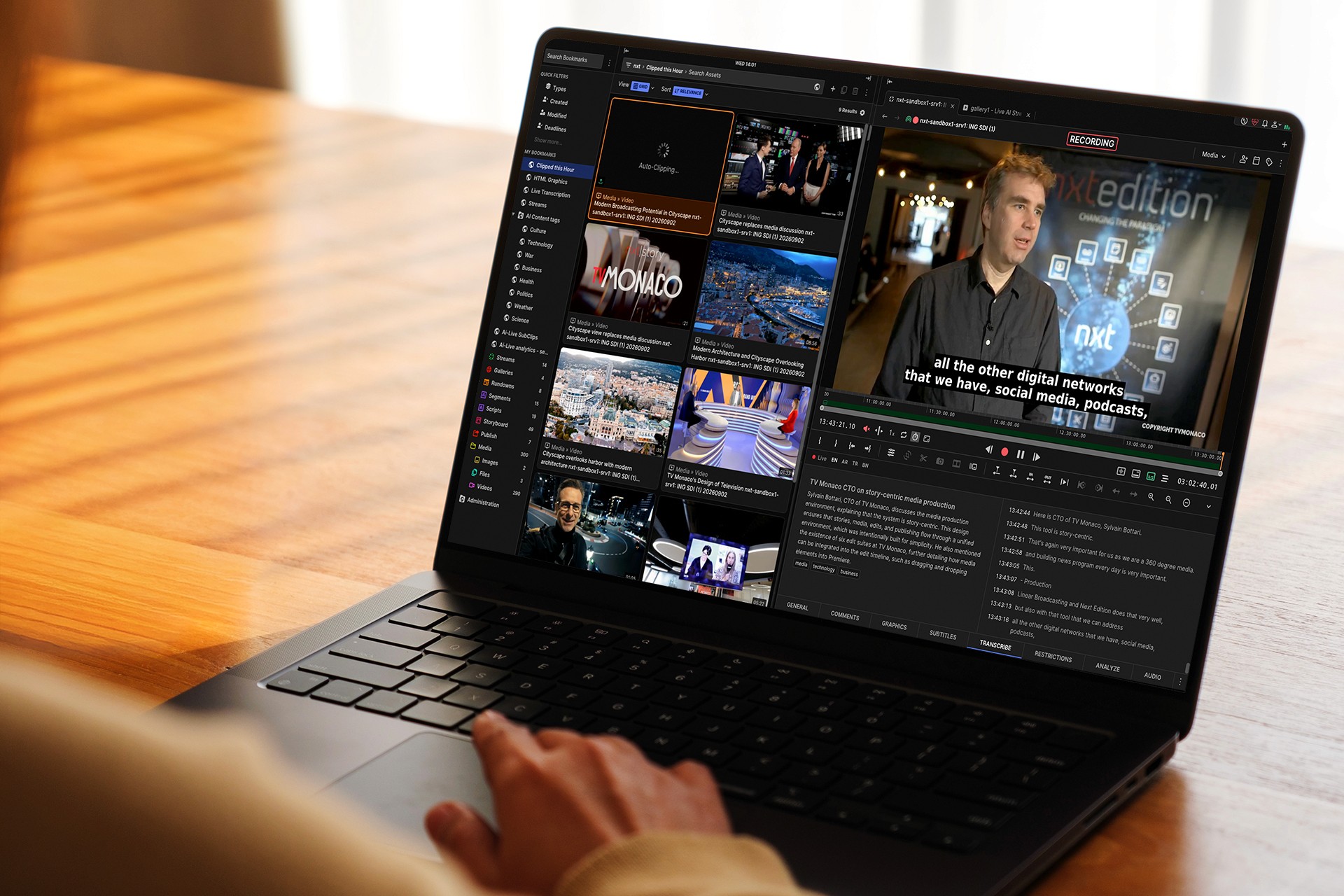
Agents work inside a single production environment, from incoming wire copy to a live studio show
nxtedition will demonstrate AI agents working the entire production chain inside a single system. Content arrives from partner Reuters. An agent develops the story, pulls relevant video from the media store, populates and applies graphics templates to that video, and assembles a running script complete with prompter text, VTs and graphics. The show is recorded in the studio and runs in the gallery. Nothing is exported to another product at any stage.
"AI needs a body," said Adam Leah, Creative Director at nxtedition. "A model on its own can write you a paragraph. It can't cut a VT, fill a graphic, build a running order or drive a gallery. We own the whole of our back end, so we can give the AI a body to work within. Everyone else needs a vendor just to connect their other vendors before the AI can touch anything at all."
Most newsroom AI produces text and hands it off to someone. nxtedition's agents have the whole back end available to them as tools: storage, compute, transcode, the newsroom system, media and production asset management, rundowns, gallery control and publishing. An agent is only as capable as the tools it can use, and these agents can use all of them.
The same approach is already carrying live news at scale: Collective Newsroom's production operation for BBC India, built with the BBC and nxtedition, is a finalist in the Content Creation category of the IBC2026 Innovation Awards, with winners announced on the IBC Conference main stage on 13 September. The project built a unified newsroom from scratch against a fixed deadline, running nine languages with transcription and translation processed on the broadcaster's own hardware.
Editorial control sits where it always has, with the AI proposing angles, new stories and breaking news to journalists in the newsroom. Journalists and the director review and edit every script and every video before it goes anywhere, using the same story-centric planning tools they already work in. The goal is removing the mechanical steps between editorial decisions, not automating the decisions themselves.
Live transcription subtitles and tags content as it is ingested, flags sections for automatic clipping, and cuts the delay between something happening and that material being usable elsewhere, running on the broadcaster's own GPUs.
Broadcasters choose where the intelligence runs. nxtedition ships GPU hardware with on-premise language models, so the whole workflow can run inside a single facility with no per-query cost and nothing leaving the building. The system is model-agnostic and can call an external model where choice matters more than containment, with deployment on-premise or hybrid. The agent tools are also exposed over MCP, so a broadcaster can drive nxtedition from an external AI assistant if it wants to, though the agents themselves have no need of it.
"The worry about AI in a newsroom isn't only accuracy," Leah added. "It's transparency, so that everyone can see what it did. Every step it takes shows up in the story-centric planning and rundown, so a journalist, producer and director can change it or throw it away. The system doing the work is the same one showing its steps, not some safeguard bolted on afterwards."
Visit nxtedition on Stand 7.A02 at IBC2026, RAI Amsterdam, from 11-14 September 2026.
Agents work inside a single production environment, from incoming wire copy to a live studio show
nxtedition will demonstrate AI agents working the entire production chain inside a single system. Content arrives from partner Reuters. An agent develops the story, pulls relevant video from the media store, populates and applies graphics templates to that video, and assembles a running script complete with prompter text, VTs and graphics. The show is recorded in the studio and runs in the gallery. Nothing is exported to another product at any stage.
"AI needs a body," said Adam Leah, Creative Director at nxtedition. "A model on its own can write you a paragraph. It can't cut a VT, fill a graphic, build a running order or drive a gallery. We own the whole of our back end, so we can give the AI a body to work within. Everyone else needs a vendor just to connect their other vendors before the AI can touch anything at all."
Most newsroom AI produces text and hands it off to someone. nxtedition's agents have the whole back end available to them as tools: storage, compute, transcode, the newsroom system, media and production asset management, rundowns, gallery control and publishing. An agent is only as capable as the tools it can use, and these agents can use all of them.
The same approach is already carrying live news at scale: Collective Newsroom's production operation for BBC India, built with the BBC and nxtedition, is a finalist in the Content Creation category of the IBC2026 Innovation Awards, with winners announced on the IBC Conference main stage on 13 September. The project built a unified newsroom from scratch against a fixed deadline, running nine languages with transcription and translation processed on the broadcaster's own hardware.
Editorial control sits where it always has, with the AI proposing angles, new stories and breaking news to journalists in the newsroom. Journalists and the director review and edit every script and every video before it goes anywhere, using the same story-centric planning tools they already work in. The goal is removing the mechanical steps between editorial decisions, not automating the decisions themselves.
Live transcription subtitles and tags content as it is ingested, flags sections for automatic clipping, and cuts the delay between something happening and that material being usable elsewhere, running on the broadcaster's own GPUs.
Broadcasters choose where the intelligence runs. nxtedition ships GPU hardware with on-premise language models, so the whole workflow can run inside a single facility with no per-query cost and nothing leaving the building. The system is model-agnostic and can call an external model where choice matters more than containment, with deployment on-premise or hybrid. The agent tools are also exposed over MCP, so a broadcaster can drive nxtedition from an external AI assistant if it wants to, though the agents themselves have no need of it.
"The worry about AI in a newsroom isn't only accuracy," Leah added. "It's transparency, so that everyone can see what it did. Every step it takes shows up in the story-centric planning and rundown, so a journalist, producer and director can change it or throw it away. The system doing the work is the same one showing its steps, not some safeguard bolted on afterwards."
Visit nxtedition on Stand 7.A02 at IBC2026, RAI Amsterdam, from 11-14 September 2026.